Crossing Fate
Play the Game here.
My Role: Creative lead
Tools: Word, Google Docs, Pixel Studio
(The final project was completed in Unity.)
Can you solve your sister’s murder—before the spiritual decay or her killer take you out?
Your missing sister Mallory Bennet has been found murdered in the forest. Police are stumped, and her killer walks free. It is up to you, psychic medium Alex Bennet, to contact her restless soul through the newspaper crosswords she now haunts. But snooping is dangerous with a murderer on the loose and contact with the spirit world threatens to corrupt your mind. You must solve her mystery before either overpowers you.
Objectives:
Implement an engaging, story-centric, solvable mystery
Design interesting and fun crosswords
Create a system of stress and recovery to add tension, consequences, and stakes

My Role
I served as the creative lead and sole writer for Crossing Fates, a monthlong project for a game design class during my junior year of college. The game’s story was told in an almost completely epistolary format, through letters, newspaper articles, ads, and crossword clues. I was responsible for:
Six distinct endings.
The game can end one of six ways. If the player successfully solves the murder, the game ends with a newspaper article detailing the killer’s arrest. Because there are four versions of the game, each with a different killer, this resulted in four success endings. Alternately, if the spirit world corrupts Alex, the game ends with an article describing a local medium going insane. If the killer catches up to Alex before the crossword is solved, the game ends with an article about their murder.
Four possible stories.
To increase replayability, I wrote a version of the game for each of the four suspects being the killer. This required me to tweak or rewrite many of the game’s texts to change the foreshadowing. (This meant 20 distinct pieces of writing in addition to the six core texts that did not change between story versions.)
Suspects and motivations.
In a murder mystery, the suspects are the story, and Crossing Fates had four: John “Bear” Brewer, Sarah Brewer, Veronica Zhang, and Daniel Newman. I gave the first three motive and opportunity; the last was a wild card (accidental killing).
Dialogue.
Each morning and night, Alex’s internal narration frames the story. I wrote dialogue to reflect their mental state and set up the upcoming events.
Advertisements.
The ads in the newspaper were also used as foreshadowing, an idea conceived of, drawn, and implemented solely by me.
-
Co-owner of Road’s End Steakhouse, husband of Sarah Brewer, friend and drinking buddy of Mallory. The night before her disappearance, the two had a mysterious, drunken argument. Her death has left him drowning in grief… or is it all a show?
-
Co-owner of Road’s End Steakhouse, wife of John Brewer. She’s never been exactly warm towards Mallory, displeased about the amount of time John spends with her and suspicious of their friendship. But she wouldn’t go so far as murder… would she?
-
Coworker of Mallory’s, new owner of Spring & Sprocket Bicycle Repair following previous boss’s retirement. Rumor has it that before her untimely death, Mallory was the favored employee slated to take the shop over instead. But surely a simple professional rivalry wouldn’t escalate to murder… would it?
-
(Wild card suspect): Reclusive owner of the poultry farm beside the park where Mallory’s body was found. With his new hunting license, he plans to rid the forest of the coyotes who keep stealing his prize chickens. With so many popular hiking trails in the area, it’s a good thing he’s got a clear enough eye and a sharp enough shot to avoid anyone getting caught in the crossfire… doesn’t he?
The Suspects
-
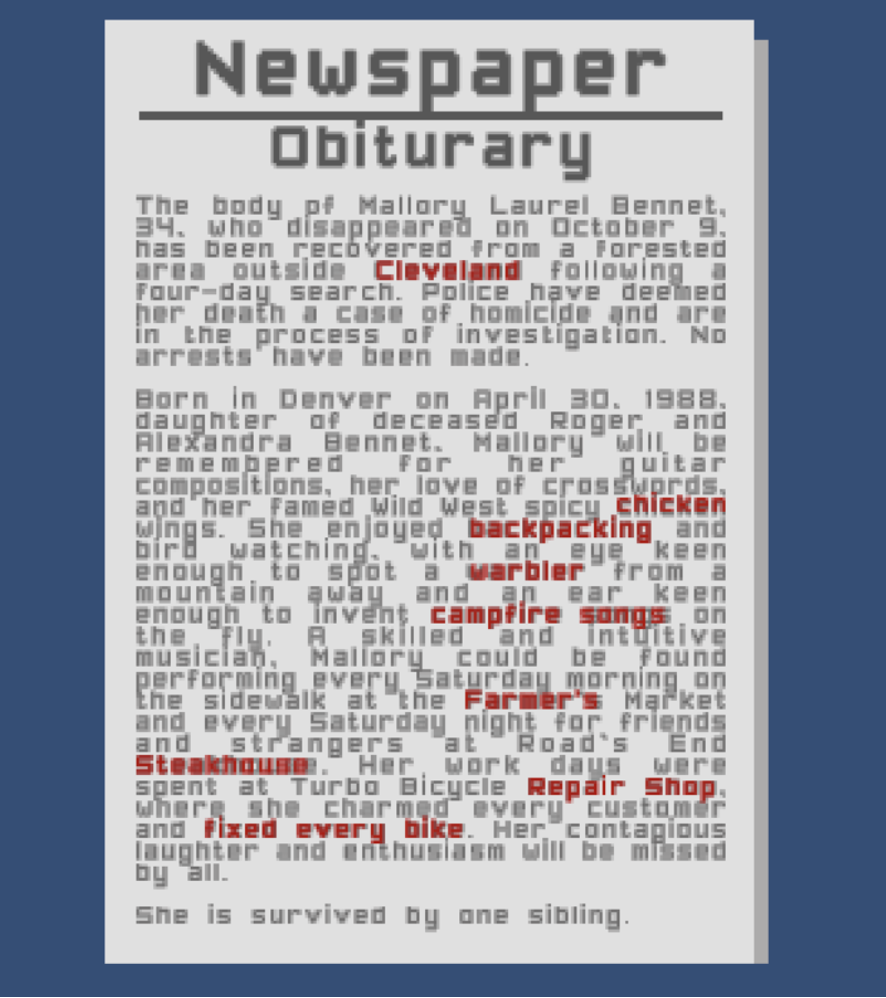
Born in Denver on April 30, 1988, daughter of the deceased Roger and Alexandra Bennet, Mallory Laurel Bennet will be remembered for her guitar compositions, her love of doing crosswords with her family, and her contagious enthusiasm for life. She enjoyed backpacking and bird watching, with an eye keen enough to spot a warbler from a mountain away and an ear keen enough to invent campfire songs on the fly. A skilled and intuitive musician, Mallory could be found performing every Saturday morning on the sidewalk at the Farmer’s Market and every Saturday night for friends and strangers at Road’s End Steakhouse. Her work days were spent at Spring & Sprocket Bicycle Repair Shop, where she charmed every customer and fixed every bike. Her bright laughter and wild grin will be missed by all.
She is survived by her twin, Alex Bennet.
-
A sudden overabundance of coyotes in the forests around Warlington have led many farmers in the area to apply for hunting permits. The scourge has involved the massacres of a number of chicken coops and death of several hundred livestock, and the disappearances of several neighborhood cats have been attributed to this presence. “They’re like a plague,” says Daniel Newman, owner of Newman Farm, one of the farms hit hardest by the Warlington Park packs. “Chasing them off, putting up outdoor lights, new chicken wire, prayer… none of it works. I’m about ready to snap. If I so much as see something moving out there, I’m liable to take care of it with my rifle instead.”
Newman, and many of his fellow farmers, have been licensed to take their fight into the nearby forests of Hickory Hills, Warlington State Park, and Sandy Creek Woods. Hikers are advised to wear bright colors and stay on the trails.
-
Hello, Cycle Enthusiasts!
I’m sure you all know the news about Mallory Bennet by now, so I’ll spare you the sobs and get right to business. Many of you probably heard that Mallory was slated to take over ownership of Spring & Sprocket, but since she’s no longer able, Lara Oaks has passed that privilege for me to take up after her retirement at the end of the month. Payments will transfer to myself as well.
Your repairs may take a bit longer than usual as we reshuffle our leadership and schedule. We promise you’ll get your bikes spick and span and back to you as soon as possible. Rest assured your repairs are in good hands.
A few of you have asked if we’re holding any memorial for Mallory, and the answer is no. Right now, the shop is focusing on getting your orders back on the road.
Yours Truly,Veronica Zhang
Spring & Sprocket Bicycle Repair -
Local psychic and medium Alex Bennet was forcibly taken to a psychiatric hospital after a mental breakdown yesterday evening. Neighbors alerted the fire department after smelling smoke, and upon arrival, Bennet was found crying and screaming, surrounded by burning shredded newspapers. Parts of their house were found deformed and warped, with unintelligible scratchings and black squares scribbled across the walls. The property has been marked off and dubbed structurally unsound.
“I don’t know what happened,” says a neighbor. “Alex was so sweet, didn’t bother anyone, showed up to picnics to do tarot readings, tame stuff… this isn’t like them at all.”
“It was Mallory,” another says. “Her death, I mean. It really got to them. I hadn’t seen them outside for days.”
Bennet will remain under close supervision for psychiatric rehabilitation but shows no signs of recovery thus far.
-
Barely a week after the murder of their sibling Mallory, Alex Bennet was discovered dead inside their Warlington home. Their body showed bullet wounds and blunt force trauma, suggesting that Bennet was shot after being overpowered by the intruder.
Investigations are still underway, but police suspect the murders of Mallory and Alex are connected. “This was likely a retaliation killing,” Sheriff Trang reported. “It seems as though Alex was attempting to investigate independently… whatever they were doing spooked the killer enough to come out of hiding again. Perhaps Alex found something.”
Any evidence Bennet may have collected remains to be seen; aside from a pile of unsolved crossword puzzles, it’s unclear what Alex had been doing that provoked the killer again.
“Maybe it was just in remembrance of her,” says Maria Martinez, a friend of Alex’s and pathologist for the WPD. “If there was one thing Mallory loved to do with Alex, it was crossword puzzles. They both would’ve hated to leave one unfinished.” She sighs. “I just hope we can solve this one last puzzle for them.”
A memorial service for the twins will be held next week at South Cemetery.
-
If the player solves the mystery, they’re rewarded with a newspaper article under the headline “Warlington State park Murder Solved by Local Psychic’ that explains what actually happened. The game then ends.
///
JOHN BREWER
Not even a week after the tragic disappearance and death of Mallory Bennet, her sibling, psychic medium Alex Bennet, cracked the case. Claiming the spirit of their sister spoke to them through newspaper clippings and her beloved daily crosswords, Alex went to the police with an accusation of John “Bear” Brewer. Alex claimed Brewer, the morning after an argument with Mallory, had followed her into Warlington State Park and shot her. The Brewers were immediately called in for questioning.
John Brewer initially claimed he had gotten up early to clean the bar the morning of the murder. This evidence was refuted separately by his wife Sarah’s recollection of arriving at noon to sticky beer puddles on the bar countertop, which indicated that John had not cleaned since the night before. Sarah did, however, attest that he was absent when she awoke and he didn’t return until that afternoon, when he reappeared drunk and sobbing. She assumed it had to do with the argument between him and Mallory and didn’t think more of it.
She was more right than she knew. During police questioning, Brewer eventually broke down and confessed to having propositioned Mallory and attempted to touch her inappropriately. She threatened to tell Sarah, then left the bar. He tracked her down the following morning to one of her favorite trails in Warlington State Park, where she often walked to clear her head. After another confrontation, where she reaffirmed her intent to tell his wife, Brewer shot her three times at close range. He dumped her body deeper in the forest in the hopes that the coyotes would deal with the evidence.
Brewer has been promptly arrested. He claims to regret his actions. The court date for his trial has not been set, but he will likely be charged first-degree murder.
To reporters, Alex said simply, “My sister can rest easy now.”
///
SARAH BREWER
Not even a week after the tragic disappearance and death of Mallory Bennet, her sibling, psychic medium Alex Bennet, cracked the case. Claiming the spirit of their sister spoke to them through newspaper clippings and her beloved daily crosswords, Alex went to the police with an accusation of Sarah Brewer, owner of Road’s End Steakhouse. Alex claimed Brewer, in a heated argument, had lashed out in violence then attempted to cover it up. Brewer was immediately called in for questioning.Initially, Sarah Brewer vehemently denied the claims, claiming a close and friendly relationship with Mallory, pointing to the altar she’d set up at the bar and the victim’s frequent patronage. This, she said, should disprove the fit of rage Alex Bennet accused her of. Her husband John “Bear” Brewer, however, admitted under individual questioning that Sarah and Mallory had not been close at all, and in fact, there had frequently been tension in their marriage over Mallory’s friendship with Bear.
Furthermore, forensic analysis of Mallory’s body found shards of glass and remnants of alcohol in her wound. Authorities have identified blunt force trauma as the cause of her death, suggesting that Mallory was hit in the head with a bottle of liquor. Close examination of the bar found remnants of blood and particles of glass between the floorboards.
Upon presentation of this evidence, Brewer proudly admitted to the murder, claiming it was justified and that Mallory had “seduced” her husband. Mallory’s death, she says, saved her marriage from Mallory’s homewrecking. John Brewer, however, denied that Mallory had ever made advances on him, revealing instead his own unreciprocated interest in her that led to their argument shortly before her death. He has since filed for divorce.
Sarah Brewer has been promptly arrested. The court date for her trial has not been set, but she will likely be charged first-degree murder.
To reporters, Alex said simply, “My sister can rest easy now.”
///
VERONICA ZHANG
Not even a week after the tragic disappearance and death of Mallory Bennet, her sibling, psychic medium Alex Bennet, cracked the case. Claiming the spirit of their sister spoke to them through newspaper clippings and her beloved daily crosswords, Alex went to the police with an accusation of Veronica Zhang, a coworker of Mallory’s and newly promoted owner of Spring & Sprocket Bicycle Repair. Alex claimed Zhang committed the murder to secure the ownership that former owner Lara Oaks had promised to Mallory. Zhang was immediately called in for questioning.
Zhang refused to answer police questions after pointing out that there was no way to prove Mallory had come to the bike shop that night—the reason Zhang had not initially been considered a suspect. Parts of Mallory’s disassembled bike, however, were found in a nearby dumpster. Also found in the dumpster was a heavy wrench that was identified as the missing part of an incomplete set of wrenches belonging to Zhang. Forensic analysis of Mallory’s body found flecks of metal in her wound, and a closer examination of Mallory’s workbench revealed dried blood caught in the gears of a bike she’d been assigned to repair.
Upon presentation of this evidence, Zhang defiantly admitted to the murder, claiming it was justified and that Spring & Sprocket should have been passed to her to begin with. Oaks’ decision to give the business to Mallory, according to Zhang, was a betrayal of Zhang’s seniority and hard work and evidence of Mallory stealing business from her. Zhang’s actions, she claims, were only fair.
Veronica Zhang has been promptly arrested. The court date for her trial has not been set, but she will likely be charged first-degree murder. In the meantime, Spring & Sprocket has returned to the care of Oaks.
To reporters, Alex said simply, “My sister can rest easy now.”
///
DANIEL NEWMAN
Not even a week after the tragic disappearance and death of Mallory Bennet, her sibling, psychic medium Alex Bennet, cracked the case. Claiming the spirit of their sister spoke to them through newspaper clippings and her beloved daily crosswords, Alex went to the police with an accusation of Daniel Newman. Alex claimed Newman, in the early hours of the morning, had mistakenly shot Mallory in a hunting accident, then attempted to cover it up. Newman was immediately called in for questioning.
Newman, who’d recently been taking advantage of a hunting license to kill coyotes in the woods around his farm, initially denied having hunted near any hiking trails. Upon a police inspection of the area, however, his bullets were found embedded in trees close to East Creek Trail. Furthermore, he’d likely been out hunting near dawn, which is both when the coyotes would be out and a favorite hiking time of Mallory’s, especially when agitated, as those who knew her attested. John “Bear” Brewer further confirmed that he’d had an argument with Mallory the night before, likely the cause of said agitation.
Even upon the presentation of this evidence, Newman staunchly denied Bennet’s accusation, but the new evidence in conjunction with the rifle bullets found in Mallory’s body and the location of her death on East Creek presented a strong case against him.
Newman was promptly arrested, since which he’s been silent on the topic of guilt or innocence. The court date for his trial has not been set, but he will likely be charged first-degree murder.
To reporters, Alex said simply, “My sister can rest easy now.”
Core Texts
The Murders & Murderers
-
Each murderer in their respective version of the game sends a threat letter to Alex, raising the stakes and providing another hint as to their identity. John Brewer’s is the most kind and personal, given he genuinely regrets the incident and knew the Bennet siblings personally. Sarah’s is chilly and patronizing, using much more refined language that paints the situation as distasteful rather than regrettable. Veronica’s is sharp, direct, and angry, conveying the active hatred she had for Mallory, which is now extended to Alex. Daniel Newman didn’t know either of the siblings, so his letter is cold, utilitarian, and impersonal.
///
JOHN ‘BEAR’ BREWER:
Alex,
I know you miss Mallory. I miss her too.
But her death saved me, and I need you to realize that yours will too if you don’t stop prying. Honor your sister’s memory and let this go.
You’re a sweet kid. Don’t get caught up in this. I would hate for something to happen to you, too.
///
SARAH BREWER:
Alex,
We all deal with grief in different ways, and I see yours has taken the form of some very ill-advised sleuthing. Of course you miss your sister, but it would be best if you kept to yourself. Put away the candles and spellbooks, Alex, and leave this one be.
I would hate to take extreme measures to stop this nosiness myself.
///
VERONICA ZHANG:
Bennet,
Stop snooping around if you don’t want to share your sister’s fate. It’ll be a whole lot less messy for the both of us if you quit now. Don’t force my hand. I’m watching you.
///
DANIEL NEWMAN
Bennet,
I hear you’re still cut up about your sister. If it’s any consolation, she died fast. I also hear you fancy yourself a sleuth.
You’d best just keep your nose out of this, or something will happen to you, too. I can’t promise it will be just as fast.
-
In every version of the game, Sarah Brewer sends Alex a letter of sympathy over Mallory’s death. For all versions where Sarah is not the murderer, the letter remains the same. It serves to disqualify Sarah as a suspect, given that her letter uses British English and the threat letter does not, which keen-eyed players will pick up on. In the version where Sarah is the murderer, the letter is overly sweet, saccharine, and schmaltzy, almost too sympathetic. It focuses more on how Mallory’s death will mean John’s attention returning to Sarah, which indicates jealousy as a motive for murder.
JOHN BREWER, DANIEL NEWMAN, VERONICA ZHANG
Dear Alex,I’m deeply saddened to hear about the loss of Mallory. She kept this floundering place alive. It pains me to have her gone, even if we weren’t the closest. But she and Bear certainly were. I swear he spent more time with her than with anyone—even I was jealous sometimes. Poor man doesn't know what to do with himself now that she’s out of the picture and all he’s got is plain old me.
I realise this is a hard time for you, but I wanted to let you know that we’re making a small memorial altar to honour her here at the restaurant and we hope travelling down here to add a little something isn’t too much to ask of you.
We also thought perhaps you’d like to take her guitar home. She left it here after her last performance. Let us know what we, as friendly neighbours, can do for you in this trying time.
Sincerest sympathies
///
SARAH BREWER
Dear, sweet Alex,
The loss of Mallory shakes me to my very core as I see how Bear weeps for her. He spent more time with her than with anyone—even myself! Oh, what am I to do for him in this time of grief? It’s time for him to turn his eyes from her to me again.
I realise this is a hard time for you, but we’re making a small memorial altar to honour her here at the restaurant, and I do hope travelling down here to add something for her dear departed soul isn’t too much to ask of you.
We also thought perhaps you’d like to take her guitar home. She left it here after her last performance. We will try to be good friendly neighbours in this difficult period.
My sincerest heartfelt sympathies -
All versions of the game have an autopsy letter pointing to the murder weapon. Because all were written by Maria Martinez, Alex’s skeptical friend and pathologist at the morgue, the voice remains the same between letters, but the details change. In John’s case, the murder was committed with a commercial handgun, ruling out the death as being a hunting accident. In Sarah’s, Mallory died when she was hit over the heat with a liquor bottle, hence shards of glass in her brain. Veronica killed Mallory with a wrench to the skull, leaving the shards of metal. Daniel, who killed her accidentally while tracking coyotes, naturally used a hunting rifle.
////
JOHN BREWER
Hey, Alex.
I’m sorry to hear about Mallory. She and I went to high school together—she was queen of the bluegrass ensemble. The reunion next year just won’t be the same without her.
A little bird told me you were doing some woo-woo mystical sleuthing of your own. You know I don’t believe in that shit, but… honestly, it’s not like the police have made any progress. So what the hell.
Listen, you didn’t hear this from me. But we’ve started the autopsy down at the station and I have it on good confidence that the bullets we found in her body were from a commercial handgun, not a rifle or a machine gun, and probably fired at close range. Bang bang, head and heart. Very intentional.
Ask the ghosts about that. Best of luck.
Maria Martinez
Pathologist, MPD
///
SARAH BREWER
Hey, Alex.
I’m sorry to hear about Mallory. She and I went to high school together—she was queen of the bluegrass ensemble. The reunion next year just won’t be the same without her.
A little bird told me you were doing some woo-woo mystical sleuthing of your own. You know I don’t believe in that shit, but… honestly, it’s not like the police have made any progress. So what the hell.
Listen, you didn’t hear this from me. But we’ve started the autopsy down at the station and I have it on good confidence that she died of blunt force trauma. Her skull was totally caved in, shards of glass up in her brain, the works. Someone smashed her.
Ask the ghosts about that. Best of luck.
///
VERONICA ZHANG
Hey, Alex.
I’m sorry to hear about Mallory. She and I went to high school together—she was queen of the bluegrass ensemble. The reunion next year just won’t be the same without her.
A little bird told me you were doing some woo-woo mystical sleuthing of your own. You know I don’t believe in that shit, but… honestly, it’s not like the police have made any progress. So what the hell.
Listen, you didn’t hear this from me. But we’ve started the autopsy down at the station and I have it on good confidence that she died of blunt force trauma. Her skull was totally caved in, shards of metal up in her brain, the works. Someone smashed her.
Ask the ghosts about that. Best of luck.
Maria Martinez
Pathologist, MPD
///
DANIEL NEWMAN
Hey, Alex.
I’m sorry to hear about Mallory. She and I went to high school together—she was queen of the bluegrass ensemble. The reunion next year just won’t be the same without her.
A little bird told me you were doing some woo-woo mystical sleuthing of your own. You know I don’t believe in that shit, but… honestly, it’s not like the police have made any progress. So what the hell.
Listen, you didn’t hear this from me. But we’ve started the autopsy down at the station and I have it on good confidence that the bullets we found in her body were from a rifle, not a handgun, and probably fired at far range. They got her in the leg and spine. Not a very good shot.
Ask the ghosts about that. Best of luck.
Maria Martinez
Pathologist, MP
-
The player character starts and ends each day by reflecting on the story events. The dialogue also points towards the mechanics of the game:
The player character starts and ends each day by reflecting on the story events. The dialogue also points towards the mechanics of the game.
///
DAY 1
Start:
Your soul, Mallory—I can feel you in these pages. What is it you want me to read?
Ah, the crossword. Of course. Just let me make some tea to concentrate…
I will find your killer, sister.
Finish:
You: Mallory?
You: Can you hear me?
You: Did it work?
Mallory: I am here…
///
DAY 2
Start:
Ugh, my head… the side effects are starting, I can feel them… the Other Side bleeding into my brain…
I think it’s time to break out the pills.
*Sigh.* Only a few left.
Huh, Sarah sent me a letter from the steakhouse. I thought she didn’t like you much, Mal. And I can still feel you here, guiding my hand to the crosswords yet again… urgh, my head…
Finish:
Mallory, I don’t understand. When will you stop making me do these pointless crosswords? Shouldn’t we be searching for the killer? I know you wouldn’t do this if there weren’t a reason, but…
Mallory: Keep going… (faintly shows Mallory)
///
DAY 3
Start:
God, this migraine won’t let up. I—I think I keep hallucinating, your face will be right there in front of me, and—and I can almost touch you, I reach out, but—
Then you’re gone. All over again.
Stay with me, but please be gentle with your sibling’s soul, Mal. Better psychics than I have gone insane over what we’re doing…
My old friend Maria is working on your body, Mal. She’s got a quick eye, even if she is a skeptic. And now she’s sent me something. Interesting…
Finish:
You: None of this makes sense, Mal.
You: Please help me help you.
Mallory: I am…
///
DAY 4
Start:
An unmarked note showed up on my doorstep. No signature, no return address…
Oh god. I think the murderer suspects what we’re doing, Mal. What if they come for me? We’re running out of time, if they know.
Stay with me, Mallory, please…
Finish:
Mallory: That’s all… you know
You: Know what? The killer? No, I don’t!
Mallory: Look… closer
///
FINAL DAY
Start:
Newspapers, crosswords, letters, paper and ink—all this useless noise, and—dammit, Mallory, where are you? Where’ve you gone?
I can barely read straight. The room is blurring. And your face is everywhere—but you’re not here—not with me—
No. No. Focus, Alex. Breathe. Think…
If her spirit has fled, then her killer is close by. They’re coming for me and I’m out of time.
I must name them now or I’ll join Mallory in the grave.
-
On Day 1 of the game, the newspaper contains an ad that foreshadows the location of the murder.
For John and Daniel, these both took place in Warlington State Park, so this consists of a tourism ad with two vaguely menacing-sounding locales (Buckshot Basin and Carver Lake).
For Sarah, the killing took place in the steakhouse bar, which the ad points to with a bottle of whiskey and a spooky slogan. Veronica murdered Mallory at the bike shop and hence the ad is for a fictional brand of bike helmet being sold there.
The ads for Veronica and Sarah also handily point towards how the murder happened, with Sarah hitting Mallory with a bottle of liquor and Veronica bashing her brains out of her noggin with a wrench.



Process
The initial idea was pitched thusly:
“A simple 2D crossword puzzle game where you are filling out the daily crossword puzzle in the newspaper. Each day is another level but slowly the articles start getting more bizarre and the puzzle almost seems like it is spelling out an eerie message. Solve the puzzles to continue the story and see how this horror mystery unfolds.”
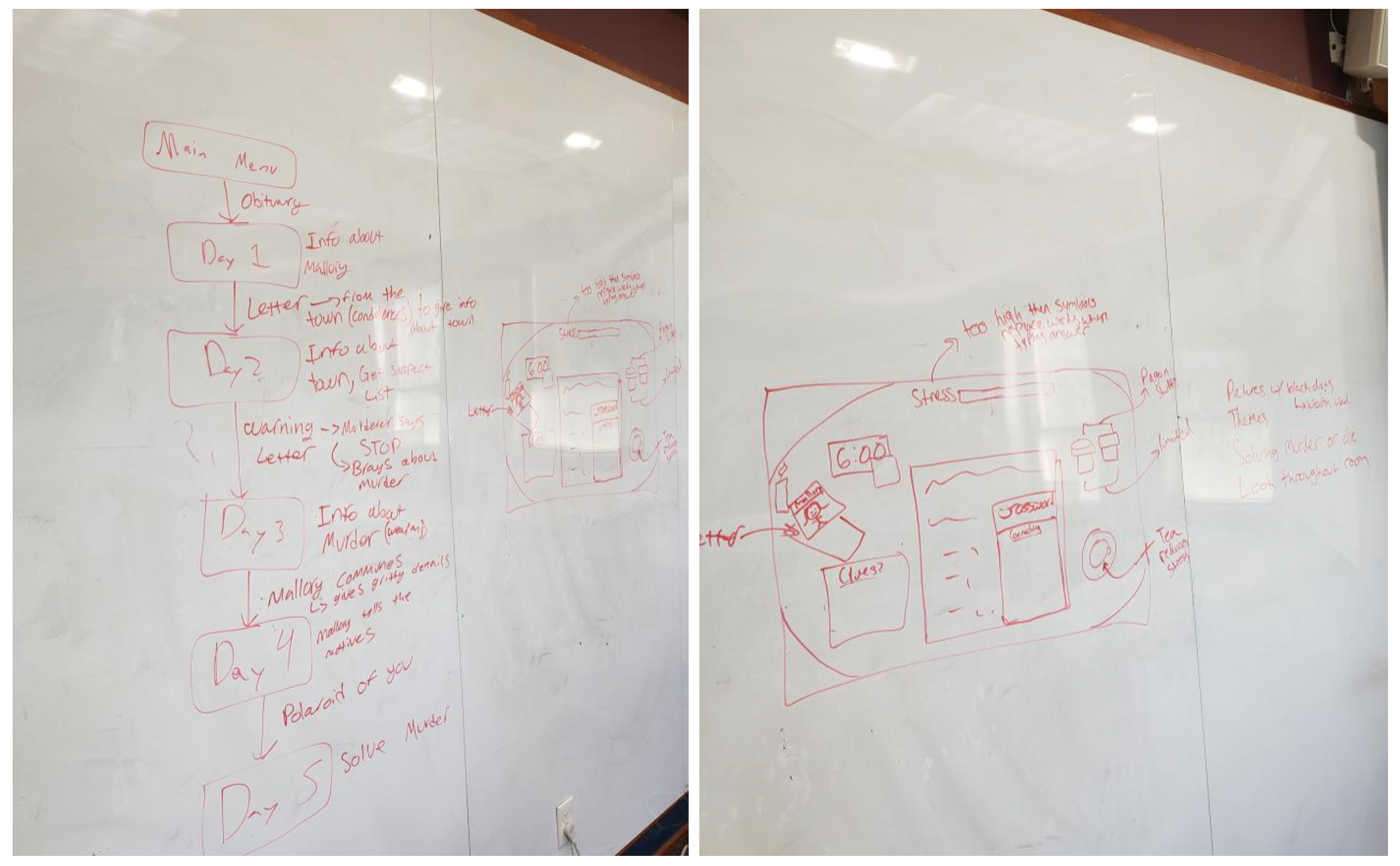
Our first team meeting was a blue-sky phase of brainstorming. After some back and forth, I proposed that the story follow a murder mystery and from there imagined the death of a family member, Mallory, and the player character’s role as a psychic medium.
The programmers hashed out some of the mechanics, such as a stress bar, coffee consumption (which became tea in the final), and anti-hallucinatory pills.
We played with and discarded ideas such as the puzzles changing each day (instead of remaining crosswords), having a more detailed room that the player could look around to find clues (rather than just a table), and different framing devices (such as having been captured by the killer). Although I would’ve liked the more detailed surroundings with, say, a shrine and string wall, we decided that was outside the programmers’ time and capacity to code. This led to simplification. After the brainstorming, we agreed that the game would include:
Only crossword puzzles
Story divided into 5 days
Player is solving the death of a family member (Mallory)
Increasing threat of the murderer catching up
Newspaper articles with foreshadowing
Stress bar, pills, and coffee (tea)
Each puzzle has a countdown timer
Initial Demo
Our first presentation of the project was a very simple demo showing the basic attributes of the game. After the demo, our main feedback was the following:
It’s not very replayable. The first version of the game had four suspects but only one killer. Once the player had solved the game, there was nothing else for them to do.
Time bar + stress bar = too much. Both metrics give the player too much to keep track of and cause unfun strain.
5 days is too long. The game will drag on too much, especially if the player has solved the mystery early in the game.
The first piece of feedback primarily concerned the game’s writing, so I set out to tackle it.
The Replayability Question
I first proposed solving this problem with a Clue-like system where the game randomized the killer, murder weapon, location, and motive and automatically picked the texts accordingly. This would mean the game could be easily replayed with different outcomes each time.
The problem with this solution was the programmers’ limited time and energy. The complex functionality of this randomizer was too much of a stretch for a project of this size, especially when they also needed to focus on uprooting bugs and creating sprites.
My second, simpler solution was the one we ran with: four versions of the game, one to account for each of the suspects being the killer. Because the writing would be entirely on my end, the coders were freed to focus on the other pieces of feedback. Although the game would have limited replayability (with only four cases), it would both improve chances of players coming back to it and fit within our limited schedule and programming capabilities.
Four Versions
Writing multiple versions of the game required me to master the voices and personalities of the four different characters, requiring me to dig deeper into their motivations and conflicts with Mallory. Six of the texts did not change between versions of the game. These five did:
Threat letter. Each murderer in their respective version of the game sends a threat letter to Alex, raising the stakes and providing another hint to their identity.
John Brewer’s is the kindest and most personal, given he genuinely regrets the incident and knew the Bennet siblings personally.
Sarah’s is chilly and patronizing, using much more refined language that paints the situation as distasteful rather than regrettable.
Veronica’s is sharp, direct, and angry, conveying the active hatred she had for Mallory, which is now extended to Alex.
Daniel Newman didn’t know either sibling, so his letter is cold, utilitarian, and impersonal,
Letters of sympathy. In every version of the game, Sarah Brewer sends Alex a letter of sympathy about Mallory’s death.
All versions except the one in which Sarah is the murderer remain the same.
In the altered version, the letter is overly sweet, saccharine, and almost too sympathetic. It focuses more on what Mallory’s death will mean for Bear’s attention returning to Sarah, which indicates jealousy as a motive.
Autopsy results. All versions of the game have an autopsy letter pointing to the murder weapon. Because all were written by Maria Martinez, Alex’s skeptical friend and pathologist at the morgue, the voice remains the same between letters, but the details change.
In John’s case, the murder was committed with a commercial handgun, ruling out the death as being a hunting accident.
In Sarah’s, Mallory died when she was hit over the heat with a liquor bottle, hence shards of glass in her brain.
Veronica killed Mallory with a wrench to the skull, leaving the shards of metal.
Daniel, who killed her accidentally while tracking coyotes, naturally used a hunting rifle.
Newspaper ads. On Day 1 of the game, the newspaper contains an ad that foreshadows the location of the murder.
For John and Daniel, these both took place in Warlington State Park, so this consists of a tourism ad with two vaguely menacing-sounding locales (Buckshot Basin and Carver Lake).
For Sarah, the killing took place in the steakhouse bar, which the ad points to with a bottle of whiskey and a spooky slogan.
Veronica murdered Mallory at the bike shop and hence the ad is for a fictional brand of bike helmet being sold there.
The ads for Veronica and Sarah also handily point towards how the murder happened, with Sarah hitting Mallory with a bottle of liquor and Veronica bashing her brains out of her noggin with a wrench.
Reflections
While I wasn’t a coder, working on Crossing Fate gave me good insight into the process and difficulties of building in Unity in a limited time frame.
Though a lot of my writing didn’t end up in the game’s final build, I believe the texts still demonstrate my ability to foreshow, write compelling game texts, and capture character voices, especially in an epistolary narrative where distinct voices make all the difference. The story, for Crossing Fate, is central; narrative is the bridge between mechanics and player and the focal point of the game. To be entrusted to create a compelling narrative was an immense honor and a lot of fun, and I’m excited to design more games like it.
Additional Contributions
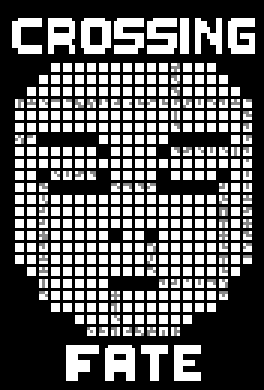
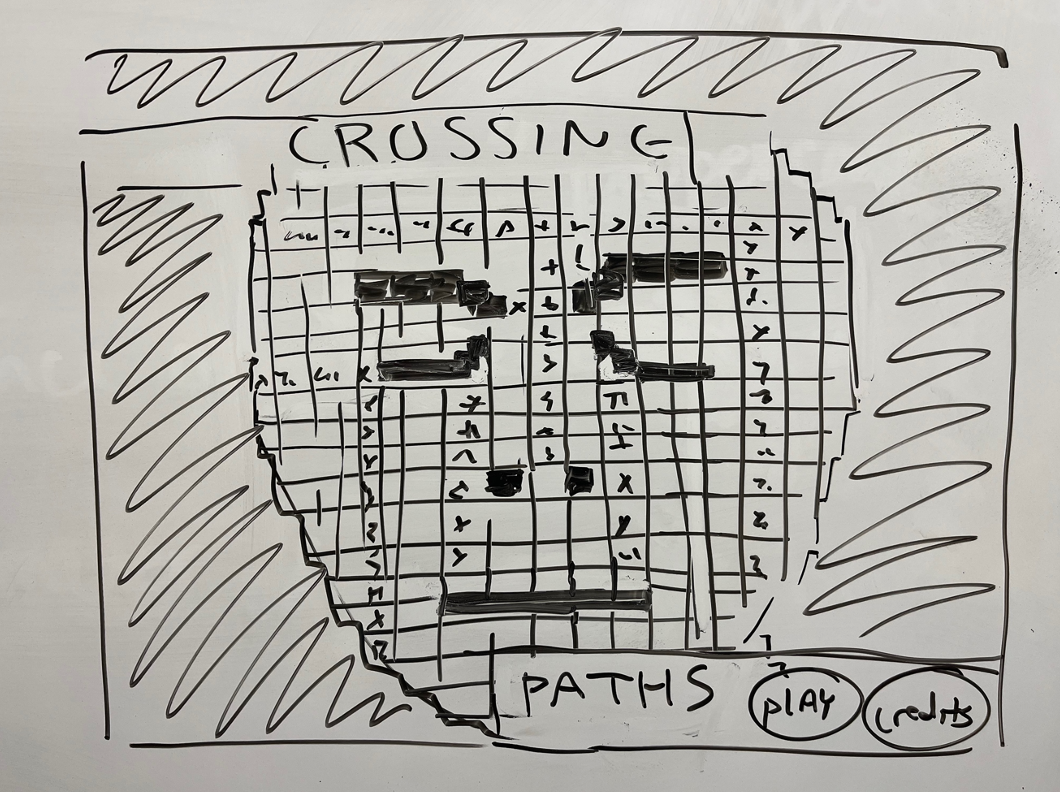
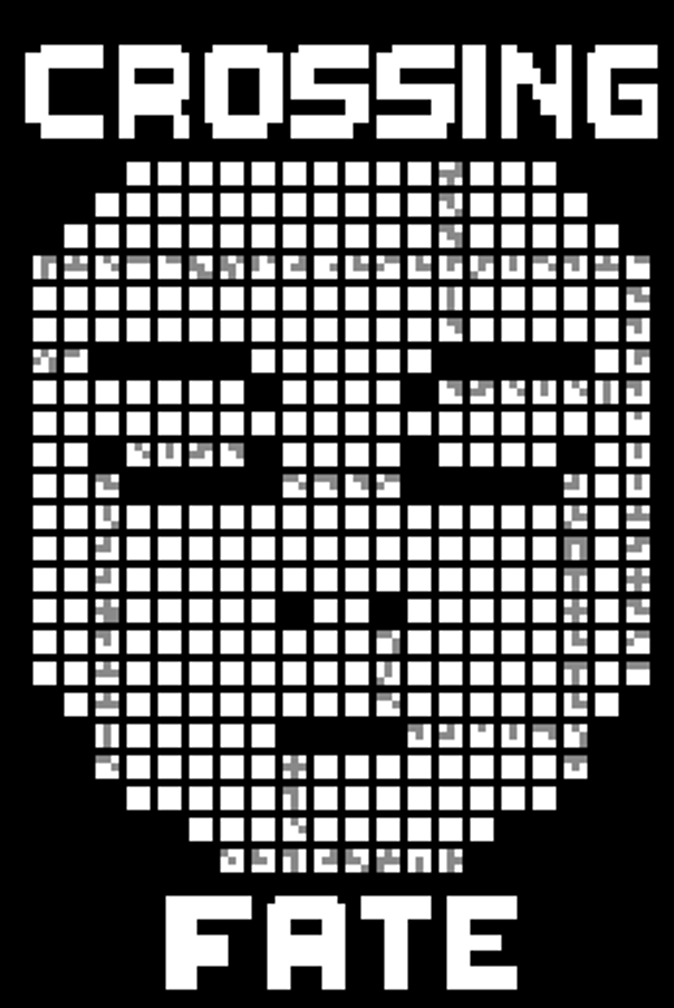
In addition to doing the game writing, I also designed and illustrated the cover image for Crossing Fate using Pixel Studio to match the pixelated style of the game.
Initial Game Obit
Brainstorming!
Draft Game Cover
Final Game Cover